

Which AI Problems Should Your Nonprofit Actually Solve? A Strategic Framework
Every nonprofit leader I talk to is facing the same challenge: AI is everywhere, the possibilities seem endless, and you have no idea how to organize your approach to this new technology:
Should you automate donor acknowledgments? Build a chatbot for your website? Use AI to analyze survey data? Predict which clients will drop off from the program? The list goes on and on.
Here's the hard truth: most AI projects don’t measure up to the hype not because the technology doesn't work, but because organizations pick the wrong problems to solve. Leaders may chose to chase shiny, low-impact wins instead of tackling the sticky, transformative challenges that actually move the needle.
So how do you decide? Let me show you a framework I use with clients.
A Throwback to Business Case Studies
I still remember sitting in the student union between classes in college, hunched over my battered, highlighted copy of Case in Point: Complete Case Interview Preparation by Marc Cosentino. Page after page of consulting frameworks like market sizing, profitability analysis, the 4 P’s of pricing, and competitive positioning. At the time, I was just trying to pass my interviews by memorizing the book. But those frameworks stick with me because they did something powerful: they turned messy, overwhelming problems into structured decisions.
The classic profitability case was simple: Revenue − Costs = Profit. Break down revenue into price and quantity. Break down costs into fixed and variable, then by category. Suddenly, a vague "how do we increase profits?" question became a clear set of levers you could actually pull. Anyone else remember drawing this out on a blank piece of paper?
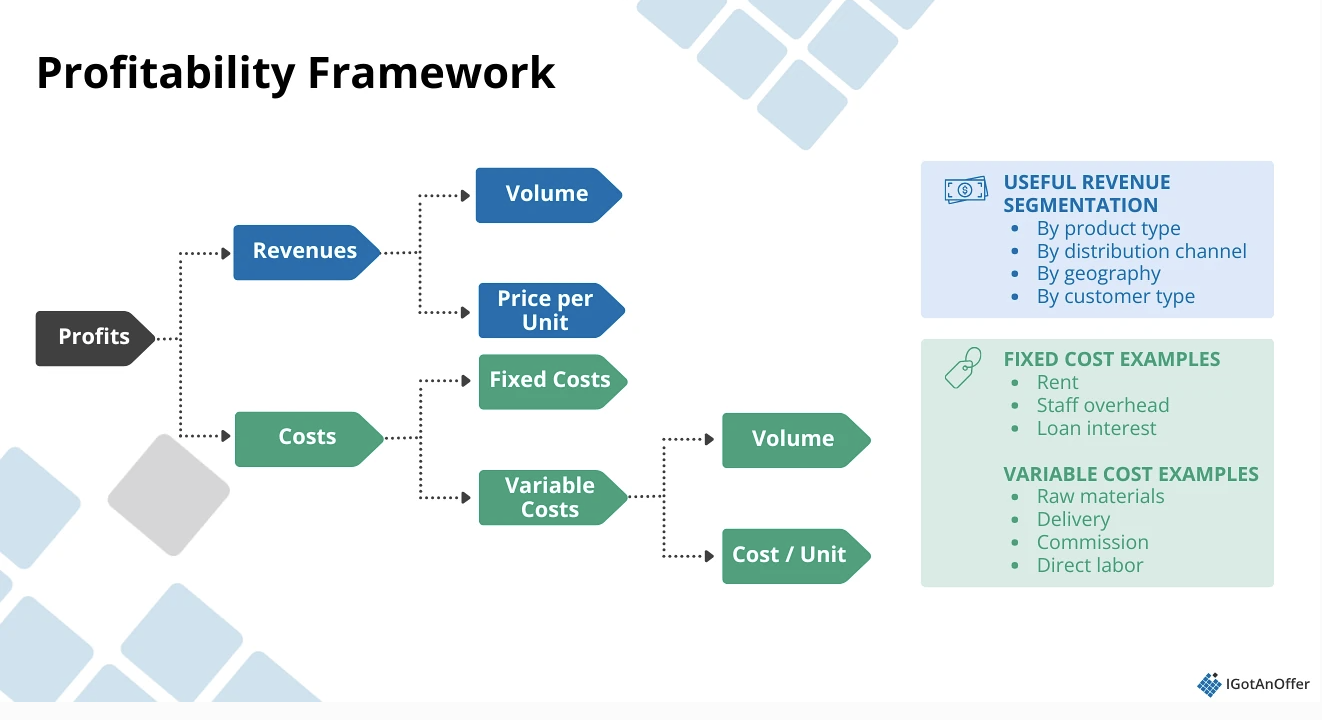
Sample Profitability Framework from https://igotanoffer.com/
I believe nonprofits can benefit from the same clarity when it comes to AI and other strategic decisions. So I've adapted that classic consulting framework for the realities of mission-driven work.
The Nonprofit Operations Equation
In traditional consulting, we think about business operations as:
Revenue − Costs = Profit
For nonprofits, I adjust this to:
Revenue − Costs → Impact Generated
Your revenue (grants, donations, contracts) minus your costs (labor, technology, admin, facilities, fundraising) should result in the impact you generate for your community. Simple enough.
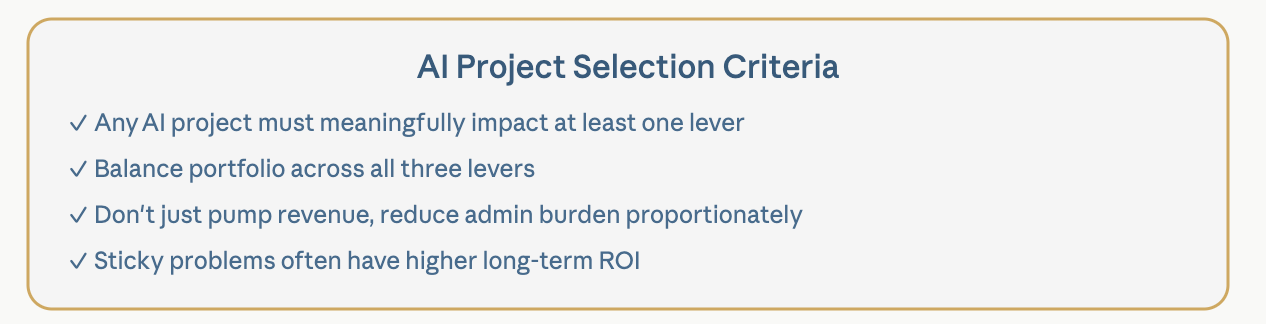
But here's where it gets useful: each of these three areas has specific levers you can pull, and a good AI project (or any strategic project for that matter) should meaningfully move at least one of them.
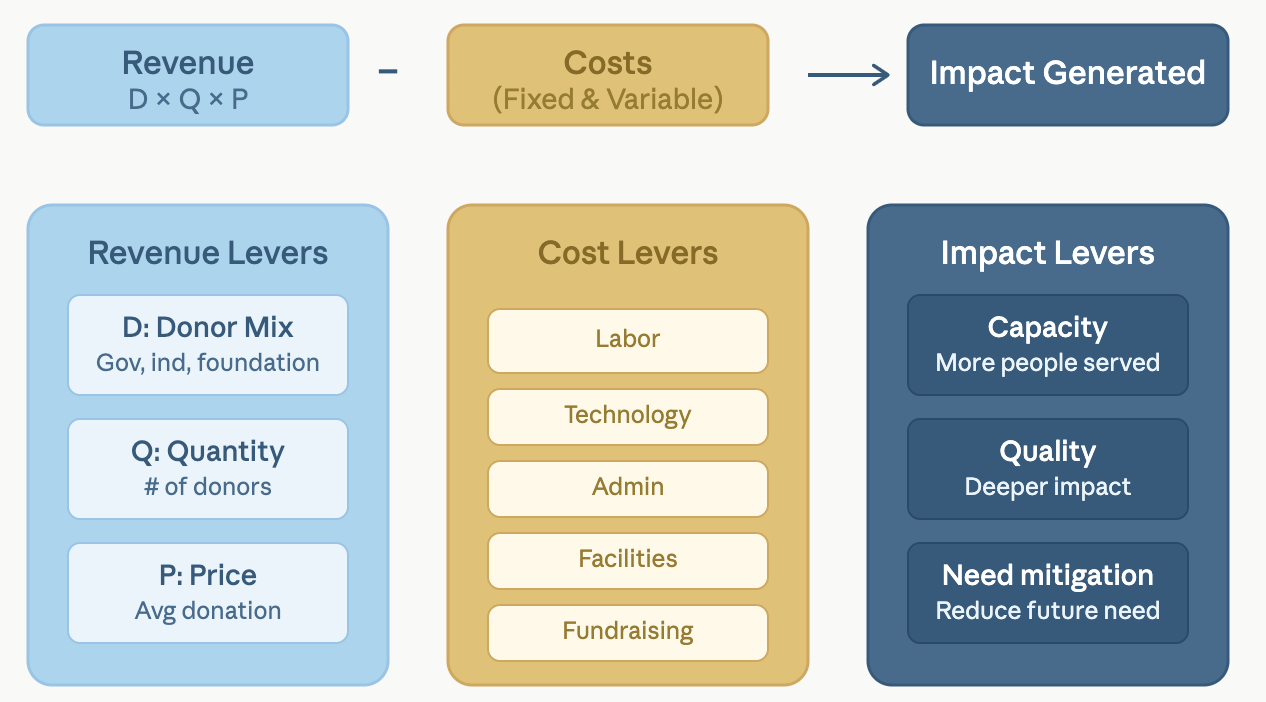
Nonprofit Impact Levers Framework created by Arensa Consulting
Revenue Levers: D × Q × P
Your revenue is driven by three variables:
D (Donor Mix): The composition of your funding sources—government grants, individual donors, foundations
Q (Quantity): The number of donors, funders, or revenue sources within the mix
P (Price): The average donation or grant size
AI projects that optimize donor mix (D): Tools that identify which funding sources are most sustainable, diversification analysis that shows concentration risk, grant opportunity matching that helps you shift toward more strategic funders.
AI projects that increase quantity (Q): Donor prospecting tools that identify likely supporters, automated outreach campaigns that reach more people, chatbots that qualify leads 24/7.
AI projects that increase price (P): Personalized ask amounts based on giving history, optimal timing suggestions for major gift conversations, proposals that analyze past winning grants to improve your ask.
Market update: There’s a ton of AI innovation happening on the revenue side! Take a look at Candid’s connector with Claude and Kindora’s funder search as two great product examples.
The trap: It's tempting to focus all your AI energy here because revenue growth feels urgent. But if you only pump up revenue without addressing costs or impact, you're just creating a bigger, more expensive version of the same operation.
Cost Levers: Fixed, Variable, and Everything In Between
This varies for every type of organization, but in general, nonprofit costs break down into:
Labor (likely the biggest expense)
Facilities
Fundraising and marketing
Technology
Admin overhead (bucket for everything else)
AI projects that reduce labor burden: Automated data entry, grants reporting that pulls from existing systems, AI-assisted case notes, scheduling tools that eliminate back-and-forth emails.
AI projects that reduce technology costs: Systems that consolidate three tools into one, automation that reduces your reliance on expensive platforms, open-source AI solutions that replace subscription services.
AI projects that reduce admin costs: Invoice processing, compliance documentation, board packet assembly, expense categorization.
The reality check: Most nonprofits have already cut costs to the bone. The goal here isn't to fire people—it's to free your team from soul-crushing administrative work so they can focus on the mission. An AI project that saves your grants manager 80% of their reporting time (like we did for a Brooklyn nonprofit) doesn't just reduce costs—it prevents burnout and creates capacity for growth.
Impact Levers: The Mission Itself
This is the fun part, where technology innovation can touch your work where it matters most. Regardless of your mission, you can conceptualize increasing impact in three ways:
1. Capacity/Efficiency: Positively impact more people the same way you already do. Examples: AI triage systems that route clients faster, predictive models that identify who needs intervention now, automated follow-up that allows case workers to manage more clients without greater admin burden.
2. Quality: More deeply impact the same people you already work with. Examples: Personalized program recommendations or improved program curriculum, real-time feedback loops that help staff adjust approaches, early warning systems that prevent clients from falling through cracks.
3. Need Mitigation: Develop new offerings or policies that reduce the need for your services in the future. Examples: Introducing a new program that helps prevent a root cause of a need, policy recommendations based on aggregated data, prevention programs targeted at high-risk populations.
The opportunity: This is where AI can be truly transformative—not just making your operations more efficient, but fundamentally improving outcomes. But these projects are often the hardest to implement because they require changing how programs actually work.
The Balance Principle
Here's the strategic insight: your AI portfolio should touch all three areas, not just one.
I see nonprofits make three common mistakes:
Mistake 1: All revenue, no relief. They implement five different donor engagement tools but ignore the fact that their program staff are drowning in paperwork. Revenue goes up, but so does burnout. Staff churn increases. The organization becomes a fundraising machine that can't actually deliver programs well.
Mistake 2: All automation, no transformation. They automate every possible administrative task but never ask whether AI could help them serve people better. They become incredibly efficient at doing the same things they've always done, missing the chance to fundamentally improve outcomes.
Mistake 3: Solving in a vacuum. They treat every AI challenge as a unique problem that only they face, building custom solutions from scratch when three other organizations in their network are wrestling with the exact same issue. They spend six months and $50K building a grants tracking system that their partner organization already solved last year. Or they hire separate consultants to build nearly identical client intake workflows, missing the chance to co-create something better and split the cost.
The collaborative approach: Before building, ask around. Is anyone in your network solving this? Could you pool resources with peer organizations to co-develop a solution that works for all of you? Share the implementation cost, share the learnings, and collectively negotiate better rates with vendors. A great example of this collaboration is the Round Table Collective of Emergency Food organizations in NYC which is using AI to improve inventory management and save money via collective purchasing.
The balanced approach:Pick projects across all three levers. Maybe one project optimizes your donor mix and increases retention (revenue), another automates grant reporting (costs), and a third improves client triage (impact). This way, you're building a healthier, more sustainable, and more effective organization, not just a more efficient one.
Applying This Framework: The Decision Filter
When someone proposes an AI or automation project at your organization, ask:
1. Which lever does this move? If the answer is vague or "all of them," it probably moves none of them meaningfully. Good projects have a clear primary lever.
2. How much will it actually move that lever? A chatbot that answers 3 FAQs is shiny but low-impact. A system that automates 80% of your grants reporting is tough to set up correctly, but extremely high-impact.
3. What's my current portfolio balance? If you've done three revenue projects and zero cost or impact projects, maybe it's time to tackle that painful administrative burden everyone complains about.
4. Is this worth the organizational effort? Implementing AI isn't free. It takes $investment$, staff time, change management, and often some trial and error. The stickier the problem, the higher the bar should be for expected impact. But don't let difficulty scare you away from transformative projects. Sometimes the hard problems are the ones most worth solving.
The Bottom Line
Not all AI problems are created equal. The shiny ones grab attention. The sticky ones create lasting value.
We don’t want to implement AI just because it’s the shiny new toy. AI is a tool in our toolkit and we want to strategically choose projects that strengthen the organization across revenue, costs, and impact. And most importantly, to balance your portfolio so you're not just building a more efficient machine, but a more effective and sustainable one.
When you're staring at a dozen possible AI projects and feeling overwhelmed, come back to this framework. Ask yourself: which lever does this move? How much? And am I keeping my organization in balance?
The answers will point you toward the problems worth solving.
Ready to apply this framework to your organization? At Arensa Consulting, we help nonprofits cut through the AI hype and identify and implement the projects that will actually move the needle. Let's talk about your strategic priorities →