

Three questions to discuss before you put “AI Adoption” on the agenda
There’s a lot of hype around AI adoption right now across all industries, but especially for nonprofits and foundations. How can we use AI to expand and maximize our impact?
Your board or leadership may be pushing your team to use AI. But before you invest in an enterprise ChatGPT subscription “to explore possibilities for impact,” pause and spend time on the following questions:
What are you pain-points?
Who on your team is responsible for leading AI strategy?
How can partnerships form to scale AI adoption?
What are your pain-points?
Before investing a single dollar into an AI tool or product, your team needs to have a shared understanding of your operational problems and your technology infrastructure. The word 'problem' can feel negative, but reframing it as an opportunity for improvement helps teams approach challenges constructively.
Where do these problems exist?
Problems are identifiable in every department and when observing cross-departmental interactions. More often than not, team members are very good at identifying their own problems within their daily operations, but may miss the broader systemic issues. Bringing teams together for brainstorm and listening sessions can help leaders collect and identify opportunity areas from across the organization.
How do they impact your bottom line or mission?
Problems drain dollars, time, energy, service quality, and scalability of impact. All of these resources are important to consider when discussing problems impacting the organization. For nonprofits, there’s also the fundraising <> operations dilemma:
If we invest in fundraising, we can grow our balance sheet and keep operations the same. The risk is that impact gets conflated with revenue generation.
If we invest in program operational efficiency, we can strengthen infrastructure and direct time and dollar savings towards new investments… but it’s less sexy for fundraising.
Neither approach is entirely correct: Balance is the key. How can teams unlock meaningful impact in both revenue generation and cost/operational efficiency?
How would you prioritize pain-points?
Everyone wants their particular problem fixed first. But as mentioned above, resources are finite. To simplify prioritization, we recommend the matrix below to identify pain points that have the highest degree of impact and highest frequency of occuring. Executive Directors and Leadership staff have the primary responsibility to ingest “problem data” from across the organization and prioritize what to solve first, second and third.
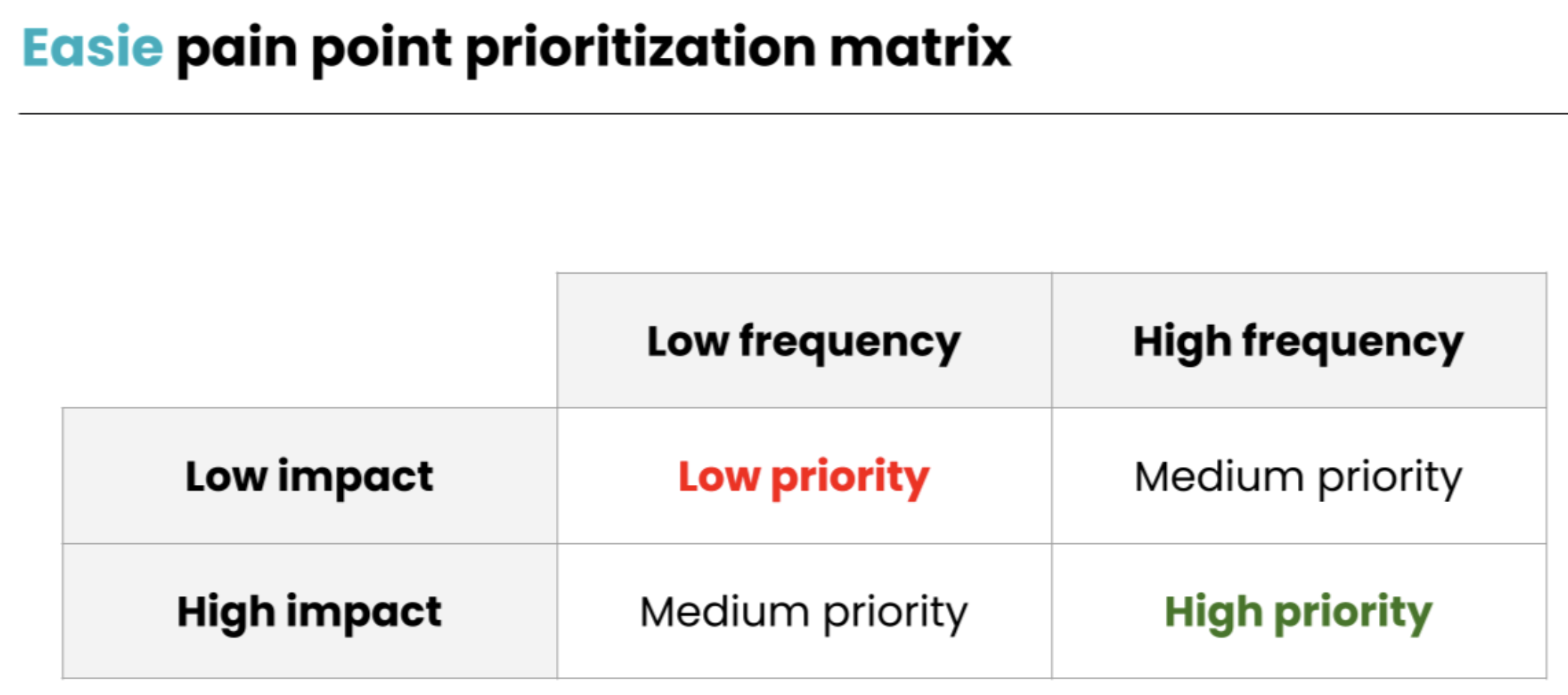
Easie and Arensa work together to help organizations prioritize their pain-points effectively.
2. Who on your team is responsible for leading AI strategy?
It’s easy to think AI => Technology => IT Department.
But in our experience, taking this approach can limit an organization’s AI adoption strategy. IT departments at nonprofits are typically lean operations primarily tasked with hardware and software management, cyber security, various database management, help desk support, and when all of that is done… only then do they put on a strategy hat. But by that time, their day job of holding the ship together has squeezed the innovation out of them.. Bottom line: Your Head of IT is focused on protecting and maintaining your existing infrastructure, not becoming an expert at AI. They are an essential collaborator, but the leadership responsibility may not be the right fit.
So if not IT leading AI adoption, who should do it? This question is harder to answer.
1) AI software and products exist within a broader toolset of automation technology. AI is one tool, but isn’t always the solution to a pain-point. Traditional automation technologies, custom portals, and integrations can make huge improvements in operational efficiency too. This landscape is complex. And its unreasonable to expect staff members at all nonprofits to develop this competency.
2) The AI technology, tools, and products are still so nascent, the skillset best suited for leading AI adoption aligns more with strategic project management than with technology.
Rather than one specific role, I’ve listed some key qualities that I believe this person should possess. Instead, consider these essential qualities for whoever takes on this leadership role:
Strategic thinking - The ability to connect AI initiatives to organizational goals and understand how technology adoption impacts operations, funding, programs, and staff. This person needs to see the bigger picture, not just what's technically possible.
Business case development - Technology investments in AI don’t look the same as a per user per month Microsoft Suite subscription. Literacy about the cost of software (LLMs usage fees, integrations, cloud storage, etc) and the ability to build business cases for investment will aid in decision-making speed and project conviction.
Change management skills - AI adoption isn't just a technology implementation; it fundamentally changes workflows and roles. This person needs to guide teams through that transition, address resistance, and help people see the benefits rather than just the disruption.
Comfort with ambiguity - AI is still evolving, best practices are still being defined, and nonprofits face unique constraints. The leader needs to be comfortable making decisions with incomplete information and iterating as they learn.
Facilitation and listening - Going beyond general collaboration, this person needs to actively listen to different departments (program, finance, operations, etc.) to understand pain points and translate between technical possibilities and real-world needs. They're a bridge-builder.
Judgment and ethics awareness - As AI becomes more powerful, nonprofits need someone who can think critically about responsible use, bias, data privacy, and whether adopting a particular tool actually serves the mission. This is especially important in the nonprofit sector where trust is foundational.
Tenacity - AI adoption in nonprofits involves limited budgets, competing priorities, and sometimes skeptical stakeholders. The leader needs resilience to keep pushing forward despite obstacles.
Some operational/domain knowledge - Ideally this person has spent time understanding how the nonprofit actually works—grant cycles, program delivery, compliance requirements—so they can spot where AI can genuinely help versus where it might create problems.
3. How can partnerships form to scale AI adoption?
Scalability is the reason technology is so powerful. But in a sector with limited financial resources, nonprofits are still figuring out to effectively do that. The scaling skillset exists for programs: The nonprofit sector frequently seeks to scale solutions, programs, and models. There are thousands of great examples of scalable solutions, but many scaling efforts fall short due to several factors. Bottom line: Effective collaboration at scale is difficult and requires its own work and financial investment.
It takes time to listen, to share, to learn, to develop governance, to brainstorm, to strategize, to design, to implement, to train, to train, and then train some more.
It takes money to convene, to synthesize, to develop, to implement, to test, and to maintain technology solutions.
These three questions are a useful starting point for organizations interesting in AI adoption for 2026. We haven’t quite solved this question yet, but our goal is to be a part of the collaborative solution.