Arensa’s 2025 Recap
Summary
2025 brought significant challenges to nonprofits including billions of federal funding cuts to human services, ICE mobilization across the country, and heightened anxiety across resourced-stretched nonprofit organizations.
Even with those challenges, 2025 also showed us the power of automation and AI to accelerate the ability to serve people and expand service & fundraising capacity for organizations.
Arensa’s client projects this year focused on program-tracking database implementation. Databases built to help staff proactively address opportunities and gaps can unlock greater efficiencies and improve observed outcomes.
As a result of these challenges, nonprofits will face demands to serve more people with fewer dollars and fewer staff. Arensa’s goal for 2026 is to help organizations solve their constraint problems and unlock new efficiencies with AI and automation technology.
2025’s challenges
This year, federal funding cuts, DOGE’s “efficiency” attacks, and ICE mobilization across US neighborhoods put strains on leaders, organizations, and communities nation-wide. In NYC, the Center for an Urban Future published a dire report earlier in December that presents “the biggest threat in a generation to the financial solvency of the city’s social services organizations and the millions of New Yorkers in need who rely on them.” (Center for an Urban Future) These cuts to date have already resulted in:
10 million fewer pounds of food in NYC food banks
Hundreds of millions cut from Medicaid to provide basic preventive healthcare
Cuts to supportive housing leaving vulnerable people in housing jeopardy
Cuts to LGBTQ-focused senior care due to corporate partners distancing themselves from “DEI”
Drops in enrollment for English as a Second Language (ESL) classes across the city
A blanket of anxiety across leaders and staff in a sector already facing strain on resources
And the hurt won’t stop there: The biggest cuts are slated to take place in 2027. Without intervention, billions will be cut from human services in NYC which can severely impact the wellbeing and safety of the city. This leaves us with huge problems to solve.
However, the year also brought meaningful progress.
AI Strategy Development for Nonprofits
Conversations around AI usage and impact this year were difficult to interpret, as the newness of the technology and solutions can make it difficult to identify real impact vs. shiny-ness. Since nonprofits have very little bandwidth to test, pilot, and research technologies, Arensa Consulting dove into research mode this year to help design the best AI adoption strategies.
How can smart technology investments help organizations adapt to the current moment?
How can technology (both traditional automation and AI) benefit nonprofits?
How can this technology be delivered to teams in an “easy-to-use” way that doesn’t require a ton of implementation time?
How can we develop scalable, low cost AI technologies?
To answer these questions, Arensa partnered with Rock Vitale, CEO of implementation consulting firm Easie, to explore the business use cases and opportunities for technology efficiency within the nonprofit sector.
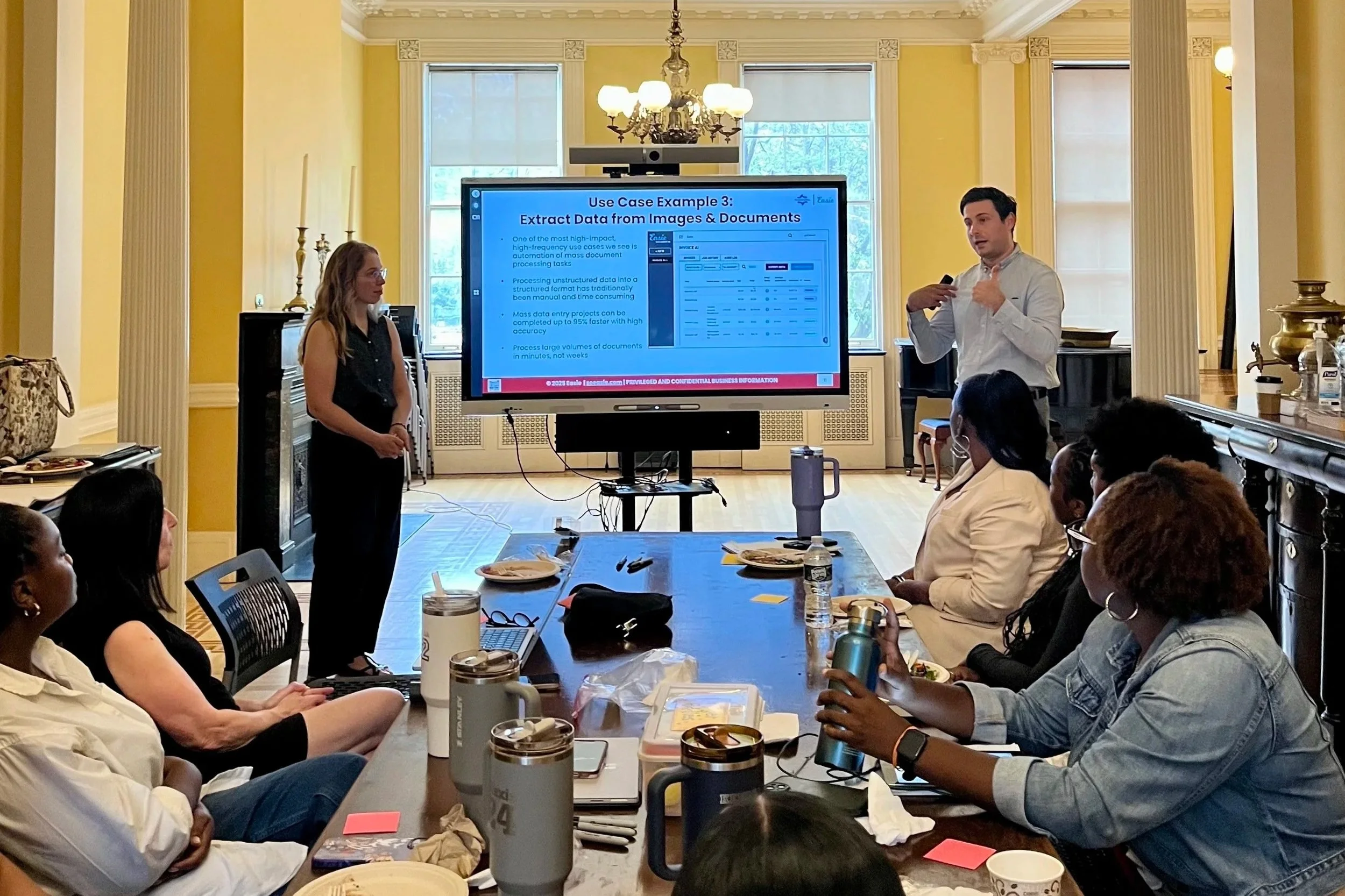
Arensa Consulting Founder Linnea Cederberg and Easie CEO Rock Vitale present an AI overview workshop to Henry Street Settlement, an New York-based nonprofit
Together, we learned:
Ideas are plenty: Nonprofits leaders are extremely skilled at identifying technology solutions that could automate steps in their processes. During discovery conversations with nonprofit leaders, we identified over 30 AI/automation use cases across HR, finance, programs, development, and operations.
Funding is delayed: Foundation partners held many events this year to convene nonprofit leaders and discuss AI, but one Chief Program Officer told us that “no funders who have hosted AI events have followed up the events with dollars to support pilots, tech investments, training, and change management.”
Nonprofits care about environmental impact: Nonprofit staff are hard-wired to care about negative externalities like energy-usage, while private companies pretty much ignore it. Nonprofits will look for AI solutions that are targeted and effective over a “try-everything” approach.
Start with the problem, then add tech: Some leaders we spoke with have purchased or are planning to purchase the enterprise version of ChatGPT in hopes that getting the technology will “solve their problems”. But deploying technology to staff without first defining key processes around tech use will waste valuable time and resources. By starting with problems, teams can prioritize and attack efficiency opportunities quickly.
“Old-fashioned” automation works well too: As AI grabs headlines, the underlying automation infrastructure that enables AI systems to function effectively often goes overlooked. Traditional automation is a great approach to reducing manual labor and increasing efficiency and using AI unnecessarily can introduce increased risk of error.
In 2026, our goal is to help social impact partners define their AI strategy and built meaningful solutions.
We want nonprofits to make smart decisions around AI implementations, including:
Model selection: Which LLM model makes the most sense for the specific AI use case (i.e. when should you use ChatGPT, vs. Gemini, Claude, DeepSeek or others)?
Usage configuration: How can we set up AI tools that price on usage instead of purchasing discounted "Enterprise” accounts with a per user per month cost that add up over time.
Active data governance: How can we show teams that AI decisions impact all facets of operations and shouldn’t just live in the IT department?
Automation type: What tasks require AI vs. traditional automation? We help identify where automation can handle repetitive, structured tasks and where AI can address the unstructured, contextual challenges that require intelligence and adaptation.
Pilot project selection: We like to ask “what is your hair-on-fire" problem? Problem identification (and prioritization of said problems) is the first step towards AI adoption success.
We want nonprofits with successful use cases to be able to share their success and scale their solution across cities.
Nonprofits deal with similar processes (fundraising, program reporting, HR, finance, grant tracking…) and AI solutions that meaningfully achieve efficiencies should be built to scale across the sector.
We plan to engage with alliance organizations and interested foundations to share our approach and partner to scale impact.
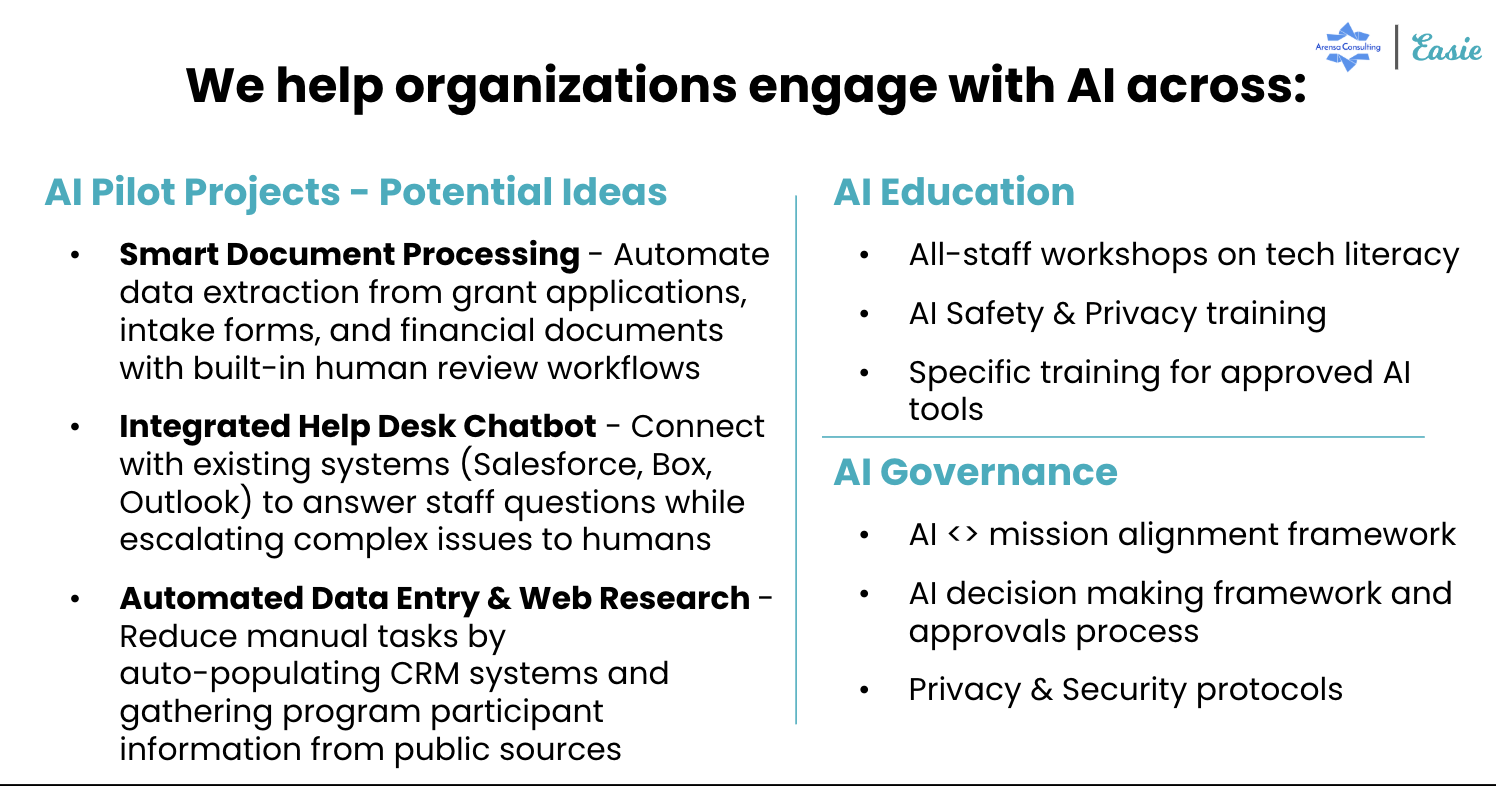
There are huge opportunities to increase efficiency and expand impact when nonprofits utilize AI. But if implemented without a strategy, thousands of important dollars can be wasted. In 2026, Arensa and Easie will partner with nonprofits to build a three-pronged approach to AI adoption that includes:
AI Education - What is the baseline level of knowledge full teams should have about AI before coordinated adoption?
AI Governance - What boundaries will your team set on internal AI use to protect clients, staff, and the organization’s security?
Pilot Projects - What problems can we solve first? Where does it make sense to use AI in processes?
Database Design and Implementation
Arensa’s client engagement this year centered around a CaseWorthy database implementation. In 2024, our human services client identified Eccovia as the best solution provider for a workforce development milestone and outcomes tracking system. Eccovia was acquired by CaseWorthy (with investment from private equity firm STG) in February 2025 which was a tumultuous transition for the client team.
Navigating this CaseWorthy merger as well as internal team transitions was challenging, but we succeeded in building a tool that will
Track placement information and retention metrics more efficiently to reduce report creation time by 90% and account for edge cases more easily (i.e. people with two jobs or people who leave a job to take another)
Automate training and job referrals between teams to decrease the “dead time” between identifying a potential match and securing a hire or enrollment
Align the “Job Readiness” milestones across all programs to provide a universal metric for “program completion” before clients get placed into jobs
Provide real-time data with easy-to-handle, drag-and-drop report creation for leadership staff
Fundraising Strategy
Finally, Arensa Consulting supported a corporate client to better define its fundraising strategy for a social impact project.
Context: A large private pharmaceutical company is partnering with a hospital network in a remote province in Argentina to source new MRI equipment and provide capacity building support. The goal of the project is to spread awareness about stroke risk and save more lives of patients experiencing a stroke in the region.
Project support: Arensa Consulting helped the project team identify a list of over 100 potential funding partners and developed a set of criteria to rank them. Additionally, we developed a high level fundraising campaign plan and communication plan for the implementation team to use later in 2026.
Life Update - I got married!
A more personal highlight from 2025 was that I got married! I’m truly blessed to have such a supportive partner who believes in my goals and projects. Here’s to a productive and expansive 2026!