

Chief Program Officers are responsible for generating impact— Can we multiply it with AI?
So much of the AI adoption conversation in the nonprofit sector revolves around Development and Fundraising. That department has a head-start playing with AI because organizations tend to focus on revenue generation (I get it. It’s a survival instinct.) So while AI can easily draft donor emails, create colorful marketing flyers, or generate a convincing grant proposal, I’m interested in looking beyond the fundraising needs to identify meaningful ways AI can help organizations run their programs more effectively.
At Arensa Consulting, we’ve helped nonprofit program teams use AI to develop a whole new performance management capability. AI can automate so many tasks leaders wish they had time for, but don’t. These include data audits, funder report creation, weekly activity emails, predictive modeling, technology pilot design.
I love working on the Program side of the nonprofit house, where the team’s main goal is impact. Whether it’s housing, workforce, education, or the arts, how can we achieve the biggest impact with the resources and team we have? This is the area of the nonprofit that typically does the most with the least, which is why I see Chief Program Officers wearing so many hats to:
Oversee the performance of numerous, diverse programs with varying eligibility, funder expectations, reporting, and histories
Manage the overall team structure, office culture, and set middle-managers up for success
Write grant proposals and collect the required documentation for grant submissions
Navigate multiple technology systems and countless data points that vary program by program
Lean in to support the hiring process (for the team that’s usually the largest)
Do all of these tasks for new programs that start and stop annually depending on funder decisions
Manage client and staff risks inherent in working in the social sector
The buzz around nonprofit AI adoption means nothing without data culture
The professional newsfeed is buzzing with statistics for nonprofit AI adoption. Are 70% of nonprofits adopting AI? 80%? 90%? To me, the simple question of “Is your nonprofit adopting AI” does not tell a compelling story. Rather than focus on the use or non-use of AI generally, researchers need to identify common nonprofit pain-points and ask organizations whether or not they’re using AI to solve that pain-point.
Separately, AI-driven operational efficiencies across teams only work if the people on the team all generally accept and contribute to a culture of data. What is a data culture?
“Data culture is the shared mindset, behaviors, and values that encourage people across an organization to use data—not hierarchy or consensus—as the basis for everyday decision-making.” - Alation
Core Elements of Data Culture from Alation article
Data Literacy: The ability of employees at every level to read, understand, analyze, and communicate with data.
Accessibility & Democratization: Making trustworthy data easily accessible across all departments rather than trapping it in technical silos.
Leadership Modeling: Executives and managers actively using data in strategic planning, program design, and operational choices.
Psychological Safety & No-Blame Approach: Treating data as a tool for collective problem-solving and growth rather than a weapon for finger-pointing.
AI is a powerful tool that can help your team build these skills towards a more data-centered culture. As Chief Program Officer or Program Manager, you can leverage AI to automate a lot of the coaching and managerial work required to increase operational efficiency, program milestones, and compliance.
AI set-up and responsible use
These use cases below are tool agnostic (Claude, OpenAI, etc) and are built to work with a single license. Nonprofit software licenses can balloon into huge expenses for organizations. At this stage of AI testing, we recommend that organizations purchase a small number of licenses and invest the remaining funds into AI change management (figuring out when and where to utilize the tool within your existing team and operations).
All work with AI raises real concerns. At Arensa Consulting, we work with clients to make sure AI projects are scoped and set within today’s context, which has been characterized by some as technofeudalism.
Privacy: de-identify client data before putting it into an AI tool, and never paste personal information into consumer tools.
Bias: historical data can reflect existing inequities, so check predictions across demographic groups.
Purpose: never use AI decision-making to screen people out of services, only to suggest additional services.
Environmental: use AI in strategic, high-impact ways that aren’t consistently draining compute and resources.
Political: position AI projects and use within a broader context of advocacy for ethical AI use in the community.
Use AI to build data culture and operational efficiency in Program teams
Here are five CPO pain-points I’ve identified with clients where AI can be a tremendous help.
1: AI-enabled Data Audit Reporting
Do you have 10+ front line staff who are responsible for entering data into a system? Do you spend a lot of time as a team reconciling the data and making sure it’s correct by going line-by-line across two Excel files? Do you have demographic fields of information on clients that are required for funder reporting?
Answer: AI-enabled data audit reporting.
Arensa Consulting specializes in connecting the strategic elements of your program (e.g., impact metrics, milestones, compliance requirements, and intake data) to AI tools that can build automated workflows.
Step 1: Identify the set of metrics or fields you want to audit across your data.
Step 2: Build de-identified data reports in your database with a recurring “Responsible party” field (this is most likely the case manager of the clients)
Step 3: Apply a data audit report logic and formatting prompt in Claude or your preferred LLM to build customized data checklists for each team member to go complete in the database
Step 4: Test the reporting output and tweak prompts to get the right set of audits
Step 5: Introduce new Data Audit Reports to your team with clear guidelines and expectations for how it will be used to measure performance
Step 6: Run the Audit report every 2-4 weeks and get real-time feedback on staff data entry progress.
The end goal? A data culture where missing data points and milestones are few and far between because your team has absorbed those data tracking practices into their everyday workflow.
2: AI-assisted report creation
If I had to take a guess, your team creates funder reports in Excel that get prepared like a potluck, rather than a catered dinner. Collaboration mode in Excel and Google Sheets is fantastic, but shouldn’t be used to sew a report together across direct-reports.
Organizations with strong data culture build reports with mathematical and logical structure once so they never have to squint and count rows again. Before AI, you would need a skilled report builder in Excel or Google Sheets who could organize the data cleanly and build formulas that weren’t going to break the second you added some rows.
Now AI is changing the game. If you understand report structure and give your LLM the right context it needs to meet your formulaic needs, it can build you a robust, flexible report in Excel very quickly.
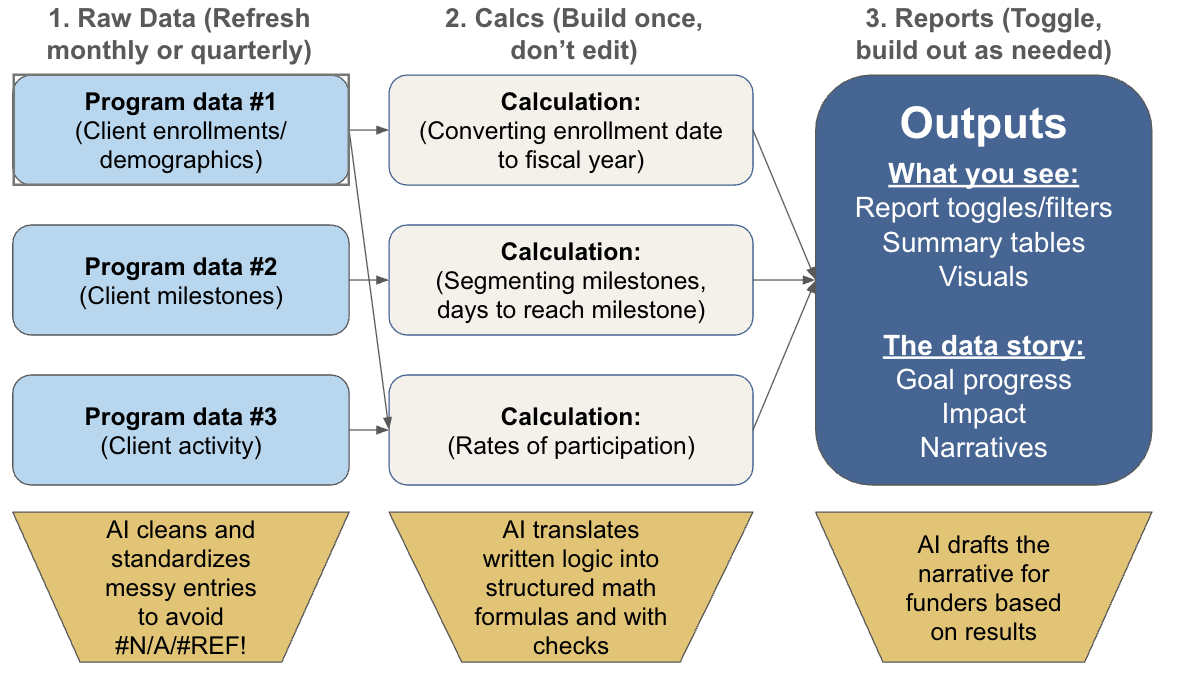
This framework shows conceptual report development steps.
Arensa Consulting helps Chief Program Officers and Program Managers build these reports and train teams to phase out existing tracker processes in favor of a unified approach. Having automated reporting shifts the focus from “Is the report accurate?” to “Is the data in the system accurate?” It helps these nonprofit leaders increase Accessibility & Democratization of the team’s data and impact, while also modeling data culture behavior as leaders.
3: Personalized activity emails
As the world becomes increasingly digitized, we expect nonprofit staff to be entering data consistently and correctly. But odds are that the system they enter data into is from 2004. The majority of client tracking systems used by nonprofits were built to put data in, but never considered that staff might want to know how the data in the system impacts their daily work.
What if you could build customized workflow tools for your staff without investing in a huge amount of “New Build” time into Salesforce, Bonterra, CaseWorthy or some other enterprise tool?
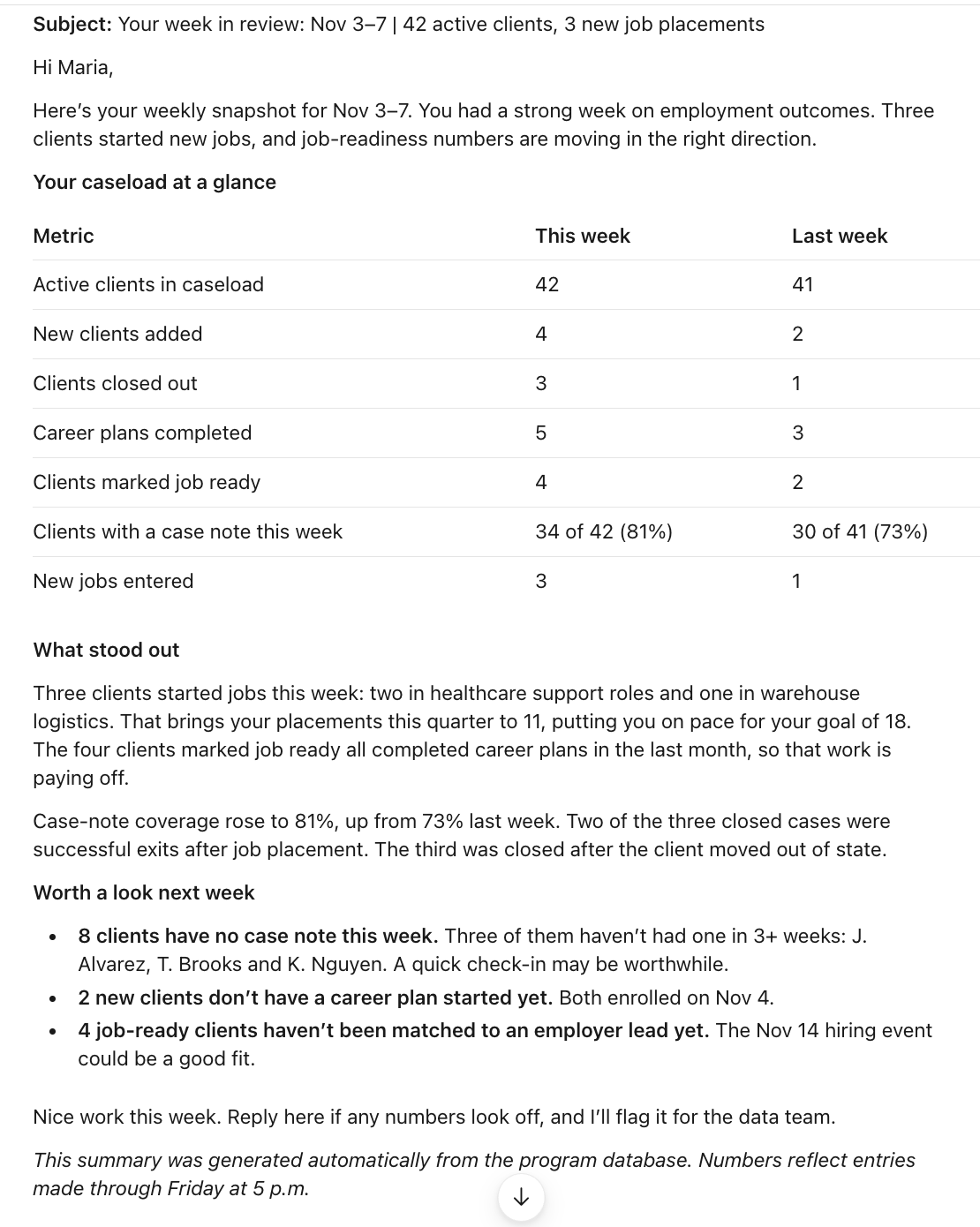
AI can help Chief Program Officers and Managers generate customized weekly activity reports that hold staff accountable for the work they’re doing with clients. Before I go further, I should say: Performance improvement reports should always be developed with input and consent from staff! As mentioned above, prioritizing psychological safety and a no-blame approach increases the success of transitioning to a more data-centered culture. If burnt-out staff members get an email about their performance with no notice, it will negatively impact the effort.
Weekly activity emails should prioritize the metrics that matter for your specific program. Here’s a sample email:
4: Predictive Modeling
Predictive modeling is a data science and statistical technique that analyzes historical data to forecast future events or unknown outcomes. In the social services and impact space, it is very difficult to run full studies on future events and outcomes because people’s lives are complex, and long-term outcome studies are expensive and slow.
AI makes predictive modeling far more accessible to internal teams. While published reports should involve qualified researchers and statisticians, internal analytics teams can use AI on their client data to analyze client behavior and drive internal team recommendations.
Chief Program Officers and Program Managers are trained to seek milestones and outcomes. What moment in a client’s participation in the program or service reflects a meaningful change or improvement in their economic, health, or wellbeing situation? Common milestones across program areas include kindergarten readiness, 3rd grade reading level, high school graduation, college graduation, job placement, job or housing retention by X months, etc.
The strongest milestones have three traits. They can be verified (documented, not self-reported only), they are time-bound (by a certain point or held for a certain period), and they are linked to long-term outcomes. Retention milestones such as “housed at 12 months” or “employed at 6 months” are often more meaningful than the first event, and they’re where good data systems and AI-generated tracking help most.
When we have clear desired outcomes from programs as our dependent variable (Does a client reach the milestone (Y) or not (N)?), then we can build a set of independent variables, or predictors, to test. We can build a set of demographic data, housing data, or program involvement data (e.g. did the client show up on day 1 of the program?) and use AI to run the independent variables against the dependent variable / desired outcome.
While the analyzing part is made easy by AI, Arensa Consulting helps organizations think strategically about what variables they want to test and what outcomes are most important to try to predict. As always, analysis needs to connect back to the main goals of the program.
A workforce program might find that clients who attend at least three sessions in the first two weeks are far more likely to be placed. That’s a signal to call anyone who misses session two. Remember: These patterns show what’s associated with success, not what causes it, so test changes before scaling them.
5: Pilot Design
Pilots are tests for future ideas. Those ideas could be completely new programs, or they could be new systems and processes integrated into existing program operations. AI can now write code and build working prototypes in hours. If your organization is interested in building out new systems and processes that improve the efficiency and effectiveness of your program operations, AI can help visualize the project and fundraise to implement the vision. Check out a few pilot demos we’ve created with clients at https://www.arensaconsulting.com/ai-solution-demos.
I hope you find these 5 AI use cases helpful. I love helping organizations build an operating model strategy that starts with pain-points and identifies the right tools to solve them. If you’re not sure where to start, I’m happy to talk through your program’s biggest pain points. Reach out or book a call.